
Michelle Mattison, MBA
August 14, 2026
If you are relocating to North Carolina, chances are you are comparing Charlotte and Raleigh. Both are growing, both have strong economies, and both offer a quality of life that attracts new residents from across the country. But they are not interchangeable. Each city has a distinct personality, job market, housing landscape, and lifestyle.
As a real estate advisor licensed in North Carolina, South Carolina, and Georgia, I help relocating buyers understand the differences so they can choose the city that fits their career, family, and lifestyle goals. Here is a side-by-side comparison to help you start.
The Big Picture
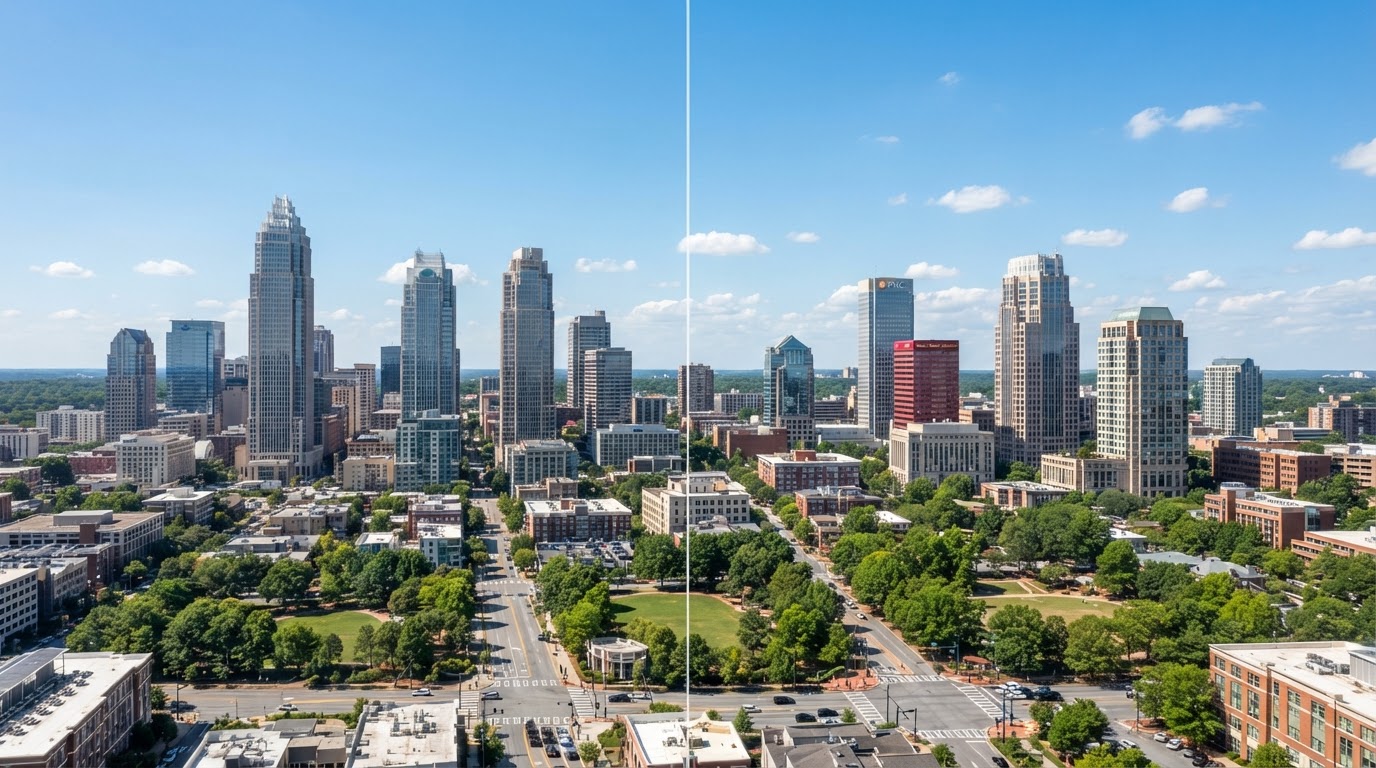
Charlotte is North Carolina's largest city, with a metro population of approximately 2.8 million. It is a major financial center, home to Bank of America's headquarters and significant operations for Wells Fargo and Truist. The city has a big-city feel with professional sports, a growing culinary scene, and a light rail system.
Raleigh is the state capital, with a metro population of approximately 1.5 million. It anchors the Research Triangle, one of the country's premier technology and research hubs, anchored by Research Triangle Park, NC State University, and proximity to Duke University and UNC Chapel Hill. Raleigh feels more like a collection of connected mid-sized cities with a strong academic and tech influence.
Side-by-Side Comparison
| Factor | Charlotte | Raleigh |
|---|---|---|
| Metro population | ~2.8 million | ~1.5 million |
| Median home price | ~$412,500 (Mecklenburg) | ~$385,000 (Wake Co.) |
| Key industries | Banking, finance, healthcare | Tech, biotech, research, education |
| Major employers | Bank of America, Wells Fargo, Truist, Atrium Health | IBM, Cisco, Red Hat, Epic Games, UNC System |
| Pro sports | NFL, NBA, MLS | NHL (Hurricanes) |
| Higher education | UNC Charlotte, Davidson College | NC State, Duke, UNC Chapel Hill |
| Public transit | Light rail (CATS) | Bus system (GoRaleigh) |
| Airport | CLT (major hub, 190+ destinations) | RDU (mid-size hub, 80+ destinations) |
| Overall vibe | Big-city energy | Academic / tech hub |
Note: Population and price figures are approximate based on mid-2026 data and are intended for general comparison. Actual prices and demographics vary by neighborhood and change over time. Verify current data before making relocation decisions.
Housing and Cost of Living
Both cities offer a range of housing options, but the character of their neighborhoods differs. Charlotte's housing landscape spans from Uptown condos to lakefront estates on Lake Norman to planned communities in Ballantyne. Raleigh's housing includes downtown condos, tech-oriented suburbs like Cary and Apex, and established neighborhoods near NC State.
Charlotte's luxury market is more established, with neighborhoods like Myers Park and SouthPark commanding premium prices. Raleigh's luxury market is concentrated in areas like North Raleigh, Cary, and parts of Wake Forest.
For first-time buyers, both cities offer affordable options. Charlotte's University City and Concord areas provide accessible price points, while Raleigh's suburbs like Garner and Knightdale offer similar value. Property taxes in Wake County tend to be slightly lower than in Mecklenburg County, but the difference is modest.
Job Markets and Career Opportunities
Charlotte: Finance and Healthcare
Charlotte is the second-largest banking center in the United States. If you work in finance, banking, or wealth management, Charlotte offers more opportunities than Raleigh. The city is also a growing healthcare hub, with Atrium Health and Novant Health as major employers.
Raleigh: Tech, Biotech, and Research
Raleigh, as part of the Research Triangle, is one of the country's premier technology and research hubs. Research Triangle Park hosts major operations for IBM, Cisco, Red Hat, and numerous biotech firms. If you work in software, biotech, pharmaceuticals, or academia, Raleigh offers a deeper ecosystem.
Lifestyle and Culture
Charlotte: Big-City Energy
Charlotte feels like a major city. Uptown offers high-rise living, professional sports (NFL Panthers, NBA Hornets, MLS Charlotte FC), and a growing culinary scene. Neighborhoods like NoDa and Dilworth offer walkable, artsy alternatives to center city. The light rail connects key areas, and Charlotte Douglas International Airport is a major hub with direct flights to most major cities.
Raleigh: Academic and Outdoor
Raleigh feels more like a collection of connected mid-sized cities. The city has a strong museum district, excellent greenway system, and a college-town influence from NC State. The Raleigh-Durham area offers strong college sports (NC State, Duke, UNC all within 30 minutes) and the NHL's Carolina Hurricanes. The greenway system is one of the best in the Southeast, with over 100 miles of trails.
Which City Is Right for You?
Choose Charlotte If You:
- Work in banking, finance, or healthcare
- Want a big-city feel with professional sports and nightlife
- Prefer a larger metro with more neighborhood diversity
- Want light rail transit and a major airport hub
- Are interested in lake living (Lake Norman, Lake Wylie)
Choose Raleigh If You:
- Work in tech, biotech, research, or academia
- Prefer a mid-sized city with a college-town influence
- Value greenways and outdoor recreation
- Want access to Research Triangle Park's employer base
- Prefer a slightly lower-key lifestyle with strong schools
The Bottom Line
Charlotte and Raleigh are both excellent places to live, but they are not the same city. Charlotte offers big-city energy, a major financial sector, and a more diverse neighborhood landscape. Raleigh offers a tech-driven economy, academic influence, and a slightly more relaxed pace. The right choice depends on your career, lifestyle, housing budget, and personal preferences.
If you are relocating to North Carolina and want help evaluating neighborhoods in Charlotte, explore Charlotte neighborhoods, access our relocation guide, or schedule a consultation to discuss your goals. Michelle Mattison helps relocating buyers find the right neighborhood and home for their next chapter.
COMMON QUESTIONS
Frequently Asked Questions
Q1Is Charlotte or Raleigh more affordable?
Raleigh tends to be slightly more affordable than Charlotte in terms of housing, though the gap has narrowed as both markets have grown. Charlotte's luxury neighborhoods (Myers Park, SouthPark, Ballantyne) command higher prices than Raleigh's most expensive areas. However, both cities offer neighborhoods at various price points. The overall cost of living is comparable, with Raleigh sometimes edging slightly lower on property taxes and insurance.
Q2Which city has better job opportunities?
Both cities have strong job markets but different specializations. Charlotte is a major financial hub, home to Bank of America's headquarters and significant Wells Fargo and Truist operations. Raleigh, as part of the Research Triangle, has a strong technology, biotech, and research sector, anchored by major employers like IBM, Cisco, and proximity to Research Triangle Park. Your industry is the biggest factor in which city offers better opportunities.
Q3Which city is better for families?
Both cities are family-friendly. Charlotte offers established suburban communities like Ballantyne, Fort Mill (SC), and Lake Norman with strong amenities. Raleigh offers planned communities in Cary, Apex, and Wake Forest, often associated with highly rated public schools. The best choice depends on your budget, school priorities, commute, and lifestyle preferences.
Q4Does Charlotte or Raleigh have more to do?
Charlotte has more major-league sports (NFL Panthers, NBA Hornets, MLS Charlotte FC), a larger Uptown entertainment district, and bigger cultural institutions. Raleigh offers a strong museum district, college sports (NC State, UNC, Duke nearby), and access to outdoor recreation. Charlotte feels more like a major metro; Raleigh feels more like a collection of mid-sized cities with a college-town influence.
Q5Which city is better for a real estate investment?
Both markets have seen strong appreciation. Charlotte's larger metro size and financial sector provide stability, while Raleigh's Research Triangle attracts high-income tech and biotech workers. Investment potential depends on the specific neighborhood, property type, and your investment strategy. Both markets offer opportunities, but Charlotte's broader neighborhood range and Raleigh's tech-driven demand each appeal to different investor profiles.